Comparison · 2 picks
Andersen A2 vs Easee One: Premium UK EV Charger (2026)
Affiliate disclosure: we may earn a commission when you buy through links on this page, at no extra cost to you. Our verdicts are our own and are not influenced by compensation.
If you have ruled out the volume-tier chargers (Pod Point Solo 3S, EO Mini Pro 3) and you want something that looks deliberate on the wall, the choice in the UK in 2026 comes down to Andersen vs Easee. Both are design-led. Both are premium relative to the £550 Pod Point bracket. They solve the 'looks-good-on-the-wall' problem in completely different ways, and the buyer profile for each is genuinely distinct.
This is a 2-way head-to-head, not a roundup. For the broader category context see our Andersen A2 review and Easee One review. If you want raw functionality at half the cost, Pod Point Solo 3S and EO Mini Pro 3 are the volume picks - both excellent at the £550 price point but visually anonymous.
At a glance
All 2 options side by side.
 |  Easee One Easee One | |
|---|---|---|
| Price | £1,200 | £549 |
| Best for | The right pick if your front wall needs something that visually belongs (Victorian, cottage, listed) or if UK manufacture is a deliberate priority. | The right pick for a modern driveway where you want the smallest, neatest installation possible. |
| Review | Read review → | Read review → |
| Buy |
The picks in detail
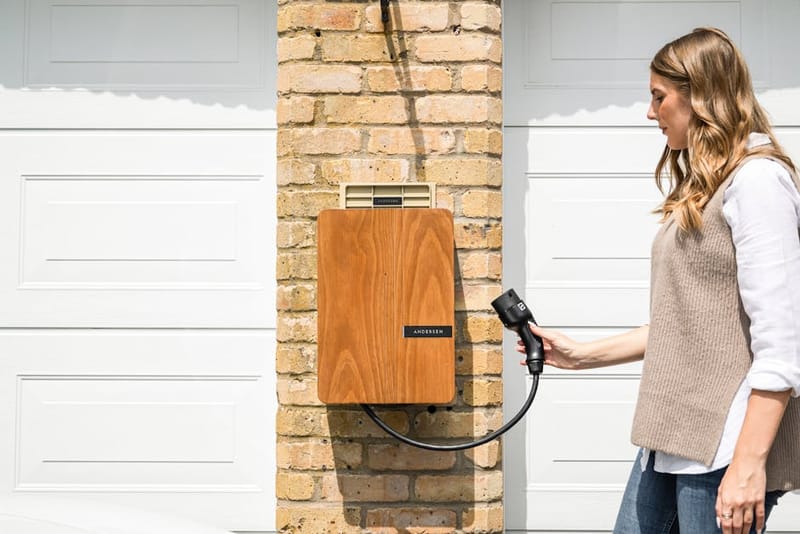
Andersen EV Andersen A2
Bottom line. The right pick if your front wall needs something that visually belongs (Victorian, cottage, listed) or if UK manufacture is a deliberate priority.
Pros
- Customisable hardwood front panel (oak, walnut, painted)
- Manufactured in the UK (Northallerton)
- Hidden internal cable storage
- Solar PV + Octopus Intelligent Go integration
Cons
- ~£1,200 installed vs £550-700 for Pod Point / Easee
- Konnect+ app less polished than Zappi or Easee
- No V2G (one-way only)
Easee One
Bottom line. The right pick for a modern driveway where you want the smallest, neatest installation possible. Best app in the category. Half the price.
Pros
- Among the smallest home chargers on the UK market (256 × 193 × 106 mm, 1.5 kg)
- Built-in eSIM with lifetime 4G subscription - no ongoing data costs
- Tethered or untethered out of the box without buying two SKUs
- Up to three units share one 32A fuse via wireless load balancing
- Available in five colours for discreet installation
Cons
- No native solar diversion mode (requires Easee Equalizer add-on for dynamic load balancing)
- Linked-device on Octopus Intelligent Go rather than a deeply integrated tariff-native charger
- No on-charger display - schedules and status are app-driven only
Where does the £600 price difference go?
Roughly half goes into the hardwood-and-aluminium build of the Andersen - the bespoke front panels, the internal cable spool mechanism, the heavier-duty enclosure. The other half goes into UK manufacturing overhead - Andersen is genuinely made in Northallerton at lower scale than Easee's European production runs, and that shows up in the price.
The functional gap is small. Both deliver 7.4 kW single-phase. Both support solar PV (with optional accessory). Both work with the major UK smart tariffs. Both are OZEV-grant-eligible with approved installers. If you cover them with a box on the wall and judge purely on kWh delivered, they are roughly equivalent. The £600 buys you the visible part.
Which has the better app?
Easee, clearly. The Easee app is the best in the entire UK home-charger category - clean UX, reliable Bluetooth and WiFi pairing, no fuss on tariff scheduling, smooth firmware updates. The Konnect+ app for Andersen is functional - schedule charging, solar mode, kWh totals - but feels less iterated, with reports of Bluetooth pairing friction the Easee has long since solved.
If you live in the app (multiple users, multiple vehicles, daily tariff switching), Easee is the materially better experience. If you set up the charger once and forget about it, the gap matters less.
Solar PV and smart-tariff compatibility
Both support solar PV, both require an optional accessory (Andersen's Konnect+ Hub at ~£100, Easee's Equalizer at ~£200). The Andersen Hub integrates more tightly with the charger because they share an ecosystem; the Easee Equalizer is a more modular add-on that also works with other Easee products.
On smart tariffs, Easee has the edge: Octopus Intelligent Go, EDF GoElectric, and OVO Charge Anytime are all native. Andersen covers Octopus and EDF but not OVO. If your tariff is or might become OVO Charge Anytime, that is a clean tiebreaker toward Easee.
Where does each one belong physically?
The Andersen A2 belongs on a wall where it can be seen. A front-elevation Victorian terrace, a cottage front, an architecturally considered modern build. The hardwood panel is the deliberate statement. Painted in the right colour it can disappear into a render or stand out as a feature. Period properties especially benefit - the corporate grey plastic alternatives clash visibly.
The Easee One belongs in a modern driveway or garage where minimalism is the point. The 200g unit (plus 1kg base plate) is the smallest 7 kW UK installation you can do. It looks at home next to a Tesla Wall Connector or in a clean garage; it would be a strange contrast on the front wall of a period property. The white plastic is not premium-feeling at handling, but it is visually quiet, which is exactly the point of the design.
Tethered vs socket: which type should you pick?
Andersen offers both (tethered with hidden cable storage, or Type 2 socket); Easee is socket-only. For most UK households, tethered is more convenient (the cable is always there, no fumbling in the boot). For multi-vehicle households or future-proofing (your next car might use a different connector), socket is more flexible. If 'always-attached cable' is what you want, that is another tiebreaker toward Andersen. If 'I will buy my own portable Type 2 cable and use sockets at home and at public chargers' is the workflow, Easee is fine.
What about V2G and future-proofing?
Neither charger supports vehicle-to-grid (V2G) - the A2 is one-way only, the Easee One is one-way only. If V2G is a hard requirement (you want to sell electricity back during peak hours), neither of these is the right pick - the Wallbox Quasar 2 (~£4,000 installed) is the only mainstream V2G option in the UK in 2026, and it is a different category entirely.
For solar export self-consumption (charging from your own solar surplus rather than exporting it cheaply to the grid), both support this through their respective accessories. The functional outcome is similar.