Ford Mustang Mach-E Home Charging UK 2026
Ford Mustang Mach-E UK home charging 2026: best tariff (Intelligent Octopus Go), best charger, FordPass app, £600-£900 saving.
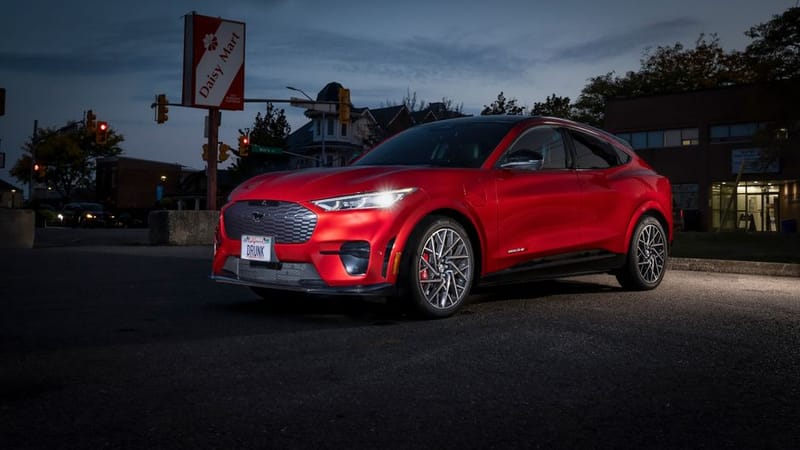
The Ford Mustang Mach-E remains the value-tier American EV of choice in the UK in 2026 - long range (~340 miles WLTP on Extended Range), 150 kW DC fast charging, and a price that has come down materially since launch. If you have one or are considering one, the home charging setup is where most owners get the biggest cost benefit.
This guide covers the UK 2026 tariff and charger picks for the Mach-E, the FordPass integration with Octopus, and the specific charging quirks owners run into.
Which UK tariff is best for a Mach-E?
Intelligent Octopus Go, with a useful native integration. The Mach-E's FordPass connected-car system integrates with Octopus's smart-charging API - you can connect Ford to Octopus in the Octopus app and the tariff will schedule charging based on your morning departure time, similar to the Tesla connection.
The integration is not quite as polished as the Tesla one (Octopus has been iterating on it through 2025-2026) but it works reliably and removes the need to schedule charging manually. For Mach-E owners, this is the closest experience to the Tesla 'just plug in and forget' workflow.
OVO Charge Anytime and EDF GoElectric are the alternatives if you prefer those suppliers. Neither has the native Ford integration but both work with manual scheduling at the charger.
Which home charger should you install?
Two strong picks.
Ohme ePod (£700 installed) - covers all four major UK smart tariffs natively. If you might switch tariffs in the next few years, Ohme is the most flexible. Pairs cleanly with FordPass + Octopus.
Easee One (£600 installed) - the value pick with the best app. Smaller physical footprint, polished UI. Supports Octopus Intelligent Go and EDF GoElectric natively. £100 cheaper.
Both are Type 2 socket-only - bring a 5m or 7.5m Type 2 cable (~£100-£150). The Mach-E ships with a basic granny cable that you would not want to use as your daily home setup.
For solar-PV households, consider Myenergi Zappi v2 (~£900 installed) - the Eco+ mode is the strongest solar-only charging implementation and pays back the extra ~£200-£300 within 18-24 months on a typical 6-8 kW PV array.
Why 22 kW chargers do not help the Mach-E
The Mach-E has an 11 kW onboard AC charger, which sounds like it would benefit from 22 kW chargers. It does not, because UK domestic supplies are almost always single-phase (7.4 kW maximum). The car cannot accept faster AC charging on a single-phase supply regardless of what the charger is capable of.
Three-phase homes (rare in the UK, mostly farms or older industrial conversions) can use the full 11 kW. For everyone else, 7 kW is the practical home ceiling. Save the £200-£500 a 22 kW charger would cost - it is wasted on a single-phase install.
For DC fast charging, the Mach-E peaks at 150 kW (Extended Range version) or 115 kW (Standard Range). That gives a real-world 20-80% charge in about 35-45 minutes at a properly-fast UK DC charger like IONITY or GRIDSERVE high-power.
How do you set up FordPass + Octopus?
Four steps.
- Make sure FordPass on your phone is connected to your Mach-E and the car is enrolled in the Connected Services (this is normally automatic on a new Mach-E; older second-hand cars may need re-enrolment).
- Sign up to Intelligent Octopus Go in the Octopus app. You need a smart meter; if you do not have one, the application triggers the install (lead time 4-8 weeks).
- In the Octopus app, go to Settings -> Integrations -> Ford. Authorise the connection between Octopus and your FordPass account.
- Set your morning departure time in the Octopus or FordPass app. Octopus picks the cheapest available window to charge to that target state-of-charge.
Once set up, charging happens automatically. The Octopus app shows the planned schedule and you can override if needed. You will see a small saving estimate vs flat tariff each week.
What is the realistic annual saving?
For an average UK Mach-E driver doing 10,000 miles per year (Extended Range efficiency ~3.0 mi/kWh = ~3,330 kWh annually):
- vs flat-rate electricity at the 26.32p/kWh price cap (October 2026): 3,330 × 26.32p = £876 vs 3,330 × 7.6p = £253. Annual saving: ~£623.
- vs public fast charging at 65p/kWh average: 3,330 × 65p = £2,165 vs 3,330 × 7.6p = £253. Annual saving: ~£1,912.
- vs Octopus Tracker (variable but typically 18-22p/kWh): 3,330 × 20p = £666 vs 3,330 × 7.6p = £253. Annual saving: ~£413.
The charger pays back from these savings within 12-15 months. As with all UK EVs, the tariff switch is the bigger lever than the charger choice - so get the smart meter and Intelligent Octopus Go in place before worrying about which charger to buy.
Mach-E specific gotchas
Three things worth knowing.
- FordPass connection can drop. The Octopus + Ford connection occasionally needs re-authorisation if you change your Ford password. If overnight charging stops happening, check the Octopus app for connection status.
- Standard Range vs Extended Range pack matters. The Standard Range pack (LFP chemistry) is fine with daily 100% charges; the Extended Range pack (NMC) prefers an 80% daily charge with occasional 100% trips. Octopus's default charge target is 80%, which suits Extended Range. Standard Range owners can set 100%.
- Plug & Charge support on public DC. The Mach-E supports Plug & Charge on networks that implement it (Tesla Supercharger CCS-open, IONITY, some GRIDSERVE high-power hubs). Set it up once via FordPass and DC charging starts automatically when you plug in - no app fumbling.