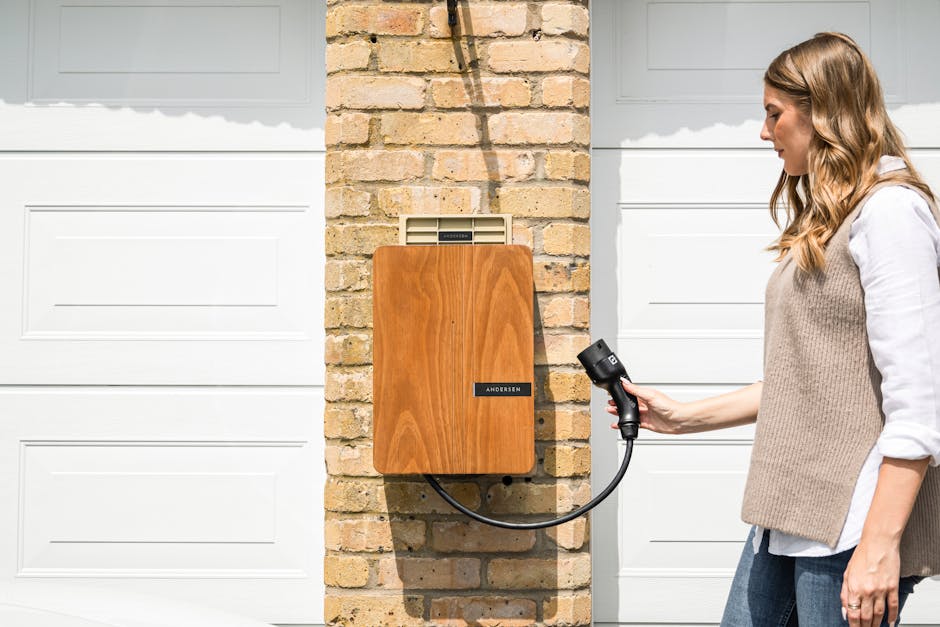
How to Install a Home EV Charger UK: 2026 Guide
UK guide to installing a 7kW home EV charger in 2026: DNO notification, fuse upgrades, BS 7671, OZEV rules, and typical £800–£1,200 cost.
Install a home EV charger UK installations are a regulated electrical job, not a plug-and-play accessory: a 7 kW charger pulls 32 A continuously and triggers BS 7671 Section 722, the EREC G98/G99 connection rules, and the Office for Zero Emission Vehicles (OZEV) installer scheme. Get the order right and the work takes a competent electrician half a day for £800–£1,200; get it wrong and the Distribution Network Operator (DNO) can refuse to energise the unit, the OZEV grant claim falls through, and the charger's earthing protection may not even be code-compliant.
This pillar walks through the full UK install process for 2026 — what your installer should be doing, what you have to check before they arrive, and where the regulations and grant rules land after the November 2025 Budget. Every claim cites the underlying ENA, IET, OZEV or DNO source.
Before you order: three questions to answer first
Sort these out before you book a survey — they decide which charger and which install path apply.
Most installation problems trace back to one of three decisions made at the wrong stage. Settle them first.
1. Is the parking off-street? If yes, the standard install path applies — your installer fits a wall-mounted unit on or close to the parking space. If your only parking is on-street, a wall unit pulling cable across the public footway is illegal under most local highway rules; you need either a bollard-mounted cross-pavement charger with a council-approved gully or a different solution entirely. The cross-pavement grant route covers this case (see Cross-Pavement Charging Grant).
2. Single-phase or three-phase supply? Around 95 % of UK homes are single-phase, which caps charge speed at 7.4 kW (32 A × 230 V). The 22 kW chargers you see advertised need three-phase, and the upgrade is rarely worth the £3,000–£8,000 cost for domestic use — most cars accept ≤ 11 kW AC anyway. We unpack this in 22kW vs 7kW Home Charger.
3. Tethered or untethered? A tethered charger has the cable bolted to the unit; untethered uses your portable Type 2 cable. Tethered is faster to plug in, untethered is tidier and lets you change cable length in future. Our breakdown: Tethered vs Untethered EV Chargers.
How a UK home EV charger installation actually works
The seven-step flow most OZEV-authorised installers follow.
Site survey (remote or in-person)
Installer reviews photos of your fuse cut-out, consumer unit, meter, and proposed charger location. They check main fuse rating, available consumer-unit space, the cable run length, and any earthing complications. Most installers price from photos and only attend if the survey turns up red flags.
DNO notification (G98 or G99)
For a 7 kW (32 A) single-phase charger the installer notifies the DNO under EREC G98 within 28 days of energising the unit. For 22 kW (32 A three-phase) units or anything above 16 A per phase the installer must apply under EREC G99 and wait for explicit approval before connection.
Main fuse check (and upgrade if needed)
Most modern UK supplies are 80 A or 100 A, which comfortably accommodates a 7 kW charger plus normal household load. Older 60 A fuses can usually be upgraded to 80 A by the DNO for free, typically within 15 working days of request. Three-phase upgrades are a longer, costlier project.
Consumer-unit work
Installer fits a dedicated 32 A breaker for the charger. If the existing consumer unit lacks space or is plastic and pre-2016, a new metal unit is often required to comply with BS 7671 Amendment 3 and Section 722. Modern chargers carry their own Type-A 30 mA RCD internally so a separate RCBO at the consumer unit is not always needed.
Cable run and charger mount
Installer runs SWA or LSZH cable (typically 6 mm² or 10 mm²) from consumer unit to charger location. Outdoor runs are clipped to walls or trenched. The charger mounts at 0.75–1.2 m above ground per BS 8300 accessibility guidance.
Test, commission, and certificate
Installer carries out the full BS 7671 inspection-and-test sequence (continuity, insulation resistance, RCD trip times, earth-loop impedance) and issues an Electrical Installation Certificate (EIC). The customer signs an OZEV declaration confirming eligibility (EV ownership, vehicle reg, address).
DNO post-install paperwork
Within 28 days of installation the installer files the formal DNO notification, retaining a copy for at least 3 years. Failure to notify is grounds for OZEV authorisation to be revoked, and the customer's grant payment can be reclaimed.
Step 1: Choose an OZEV-authorised installer
The OZEV authorised-installer scheme is the gateway to every chargepoint grant. Even if you do not qualify for a grant (homeowners with a private driveway have not been eligible since the EVHS scheme closed in April 2022), choosing an OZEV installer is still the safer signal — the requirements line up with industry good practice.
OZEV requires every authorised installer to:
- Hold a valid Competent Person Scheme (CPS) registration with NAPIT, NICEIC, SELECT or OFTEC for residential work, or hold ECA membership.
- Notify the DNO in writing of every chargepoint installed and retain that evidence.
- Retain all installation documentation (certificates, photos, customer declarations) for a minimum of 3 years.
- Submit at least one grant claim within every two-year window to keep their authorisation active.
- Permit OZEV (or a third party it appoints) to audit installations on site.
If an installer is not on the OZEV list, that does not automatically make them unqualified — but it does mean they cannot process any of the five chargepoint grant schemes on your behalf, and a key compliance signal is missing. The full register lives on the GOV.UK chargepoint-grants page.
Step 2: DNO notification — G98 or G99?
Every UK home is connected to a DNO, the regional monopoly that owns the cables and main fuse up to your meter. The six DNOs are UK Power Networks (East and South East), Northern Powergrid (North East and Yorkshire), SP Energy Networks (Central and South Scotland, Merseyside, Cheshire, North Wales), Electricity North West, SSEN (South and North Scotland), and NIE Networks (Northern Ireland).
EREC G98 and G99 are the Energy Networks Association engineering recommendations that govern how additional load (including chargers and battery storage) gets connected. The thresholds are absolute, not advisory:
G98 vs G99 thresholds
| Specification | Value |
|---|---|
| G98 — single-phase limit | ≤ 16 A per phase (≈ 3.68 kW) |
| G98 — three-phase limit | ≤ 16 A per phase (≈ 11.04 kW) |
| G99 — applies above | 16 A per phase, up to 200 kW |
| G98 process | Connect first, notify DNO within 28 days |
| G99 process | Apply to DNO and wait for approval before connection |
| Standard 7 kW (32 A) home charger | G99 (above the 16 A G98 limit) |
| 22 kW three-phase charger | G99 (well above 16 A/phase) |
That last row trips up most homeowners and even some installers: a 7 kW charger draws 32 A on a single phase, which is above the G98 16 A/phase limit. Strictly, that is a G99 connection and needs prior approval. In practice DNOs handle the volume of 7 kW domestic chargers via streamlined fast-track G99 processes, and the OZEV authorised-installer DNO-notification workflow is built around this. Your installer handles it; the timeline is normally days, not weeks.
Where it matters more is on demand connections issued after 1 April 2023: under the connection-charging methodology, demand customers are no longer billed for distribution network reinforcement — that cost has shifted to the wider use-of-system pool. Accepting a connection offer is now mostly a matter of paperwork rather than capital cost, and the customer has 90 days to accept once a quote is issued.
Step 3: Will you need a main fuse upgrade?
The main fuse — also called the cut-out, sealed inside the grey or black box where the supply cable enters your house — is owned by your DNO. Your supplier owns the meter and meter tails; an electrician owns the consumer unit and consumer tails. Knowing the boundary matters because no one but the DNO can legally upgrade the main fuse.
Most UK homes built or rewired in the last 20 years have an 80 A or 100 A main fuse. Older properties may still have a 60 A (and a few have 30 A). The threshold for a hassle-free 7 kW install is roughly:
- 100 A main fuse: almost always fine for a 7 kW charger plus normal household load, including an electric shower running concurrently.
- 80 A main fuse: generally fine. Modern chargers have built-in load management that throttles charging when other appliances draw heavily.
- 60 A main fuse: usually upgraded for free to 80 A (or 100 A if cabling permits) by the DNO. UKPN's published timeline is a free site visit within 15 working days of request.
- 30 A main fuse: upgrade is essential and may involve a new service cable, which can incur charges.
The catch: before the DNO will upgrade the main fuse, the meter, meter tails, fuse board and consumer tails need to be the right size for the new rating. That is the homeowner's responsibility, via the supplier (for tails on the supply side) and an electrician (for the consumer unit). UKPN's guidance is explicit on the ownership chain: "We own your main electrical fuse and the fuse holder. Your electricity supplier owns your electricity meter and the meter tails."
A subset of installers will shortcut this by load-managing the charger to throttle when the rest of the house pulls high current — Ohme, Hypervolt and Zappi all support this in firmware. Load management is a legitimate alternative to a fuse upgrade for many homes; it is not a substitute when the existing supply genuinely cannot accommodate even modest concurrent demand.
Step 4: BS 7671 Section 722 — the wiring rules
Every UK domestic EV charger installation since August 2020 must comply with BS 7671:2018 Amendment 1, Section 722. The IET maintains the standard; SELECT, NAPIT, NICEIC and OFTEC certify electricians against it. Five points decide whether a job is compliant:
1. RCD protection — at least Type A, 30 mA
Regulation 722.531.2.101 requires each charging point to be protected by its own RCD of at least Type A with a residual operating current ≤ 30 mA. Most modern home chargers ship with this RCD built into the unit itself, which means the consumer-unit-side circuit can be fed from a standard MCB rather than an additional RCBO. Older chargers or budget units that rely on the consumer-unit RCD need that RCD to be at minimum Type A — not the older Type AC, which is no longer compliant for EV charging.
2. PEN-fault protection on PME supplies
The vast majority of UK homes use a PME (Protective Multiple Earthing, also known as TN-C-S) earthing system. Under Regulation 722.411.4.1, a PME earthing facility must not be used for outdoor charging unless one of five mitigation methods is implemented. The five permitted methods are:
- A balanced three-phase installation (rare in domestic settings).
- Connecting the main earthing terminal to a separate, low-resistance earth electrode.
- A device that disconnects line, neutral and PE within 5 seconds when the voltage between the PE and Earth exceeds 70 V rms.
- A device that disconnects when supply voltage falls below 207 V or rises above 253 V rms.
- An alternative device that delivers equivalent safety to methods 3 or 4.
For domestic single-phase installs, methods 3 and 4 are dominant — they are now built into virtually every OZEV-listed charger (Pod Point Solo 3S, Hypervolt Home 3 Pro, Ohme Home Pro, Easee One, myenergi Zappi). The point of this regulation is the open-circuit PEN-fault scenario: if the combined PEN conductor in the supply network breaks, your earth and neutral suddenly differ in voltage and the chassis of an EV plugged into a charger can become live. The voltage-monitoring device cuts the supply before that becomes a touch hazard.
3. EV-marked socket-outlets
For untethered installations, Regulation 722.55.101.0.201.1 requires the AC charging socket to comply with BS 1363-2 (the 13 A plug standard's IEC equivalent) and to be marked "EV" on the rear. This is a small thing that a competent installer handles automatically.
4. Mounting height
BS 8300-aligned guidance places the EV socket-outlet between 0.75 m and 1.2 m from finished floor level. The accessibility logic is the same as for normal domestic sockets.
5. Test schedule and EIC
The installer must run the full BS 7671 inspection-and-test schedule (Regulation 643.8 specifically governs RCD operational testing) and issue an Electrical Installation Certificate. Keep the EIC — it is the document home insurers and house-sale conveyancers ask for.
Step 5: Cable routing, OCPP, and charger placement
The mechanics of getting cable from consumer unit to charger drive most of the cost variance. A 5 m run with a clear path between the cupboard under the stairs and the driveway side wall is a 90-minute job; a 25 m run that needs to go up the loft, across joists, through a cavity wall and into a brick-built outbuilding can take a day and add £150–£300. Most installers cap the included cable run at 10–15 m and quote per metre beyond that.
Three placement decisions matter:
- Driveway-front vs side-return. Driveway-front is more visible (a small theft and aesthetic consideration) but allows shorter cables and easier connection. Side-return placement is tidier but adds cable run; budget another £80–£150 if the run goes through a cavity wall or under boards.
- Cable length on the charger itself. Tethered chargers come in 5 m or 7.5 m. 5 m is fine for forecourt-parked cars where the charge port faces the unit; 7.5 m is safer for awkward orientations. With an untethered unit you bring your own portable Type 2 cable, typically 5 m.
- Network connectivity. The Smart Charge Points Regulations 2021 require chargers to retain smart functionality offline, but you still want the charger reachable from the manufacturer's app for tariff scheduling and firmware updates. Most home chargers connect over Wi-Fi or 4G; some (Andersen, Wallbox Pulsar Max) accept an Ethernet cable carrying OCPP (Open Charge Point Protocol) traffic. If you want bulletproof connectivity for tariff integration with Intelligent Octopus Go or similar, run a Cat 6 cable from the router to the charger location while the install is open. It is significantly easier than retro-fitting Ethernet later.
Step 6: Smart Charge Points Regulations 2021 compliance
Every chargepoint sold in Great Britain for domestic or workplace use since 30 June 2022 must comply with the Electric Vehicles (Smart Charge Points) Regulations 2021. The regulation lives at SI 2021/1467 and is enforced by the Office for Product Safety and Standards (OPSS). Five practical requirements:
- Default off-peak hours. The charger must ship pre-set to not charge during 8am–11am and 4pm–10pm on weekdays. The owner can change these defaults — and most do, to align with their own EV tariff window — but the factory state has to avoid the system peaks.
- Randomised delay function. Each charging session has up to 10 minutes of random delay built in, to stop the synchronised demand spike that would otherwise hit the grid every time half-hourly tariffs flip cheap.
- Continued charging when offline. The charger must keep working if the network drops. "Smart" features may degrade gracefully, but no one should be locked out of their own car because their broadband is down.
- Supplier interoperability. Switching electricity supplier must not break the smart features. This is what shut down the era when chargers were locked to a single supplier's tariff.
- Cyber security to ETSI EN 303 645. The standard governs IoT security baselines. Default passwords, an updatable firmware path, vulnerability disclosure: all required. Cyber-security clauses entered force on 30 December 2022.
The relevance to a homeowner: if you are looking at a charger that is not on the OPSS-recognised compliance list (or that is being sold at a suspiciously low price by a non-OZEV installer), it may be a legacy unit predating the 2022 cut-over. The full list of approved units is published on GOV.UK. All of the chargers we cover in our reviews — Pod Point Solo 3S, Hypervolt Home 3 Pro, Ohme Home Pro, Easee One, and myenergi Zappi v2 — are compliant.
Step 7: Test, commission, and hand over
The visible end of the install is a wall-mounted charger you can plug your car into. The paper end is the bit that matters when something goes wrong years later. Make sure you receive:
- Electrical Installation Certificate (EIC). The BS 7671 standard document confirming the work was tested and signed off. Required for buildings insurance, future warranty claims, and house sale.
- OZEV grant declaration receipt (if you are claiming a grant). The customer signs to confirm eligibility; the installer files the claim.
- [DNO notification](/blog/dno-notification-g98-g99-ev-charger/) confirmation. A copy of the G98/G99 form the installer submitted, retained for your records.
- Manufacturer warranty registration. Most home chargers carry 3-year warranties; Pod Point Solo 3S ships with 5 years. Register the unit on the manufacturer's portal — claims start there, not with the installer.
- App pairing. The installer should pair your charger with the manufacturer's app, confirm Wi-Fi connectivity, and run a test charge session to verify the smart-tariff schedule works.
Typical UK install costs in 2026
Industry pricing data from Checkatrade and major installer networks puts a standard 7 kW home charger install at around £1,110 in 2026, with most jobs landing between £800 and £1,200. The rough split:
Typical 7 kW home charger installation cost breakdown (UK, 2026)
| Specification | Value |
|---|---|
| Charger unit (hardware) | £400–£700 |
| Standard installation labour | £400–£500 |
| Total — typical install | £800–£1,200 |
| Add: long cable run (>10 m) | £50–£200 |
| Add: consumer unit upgrade | £300–£600 |
| Add: main fuse upgrade (if non-trivial) | £0–£500 |
| Add: three-phase upgrade | £3,000–£8,000 |
The most common cost-pusher is the consumer unit. UK regulations have tightened twice in the last decade and many homes still run plastic boards from before the 2016 BS 7671 Amendment 3. If your board is plastic and full, expect a new metal consumer unit on top of the charger work — £300–£600 depending on how many circuits need re-terminating. An electrician's day's work, in other words; not catastrophic, but worth knowing about before the survey.
Three-phase upgrades are the only large cost. The DNO charge is moderate (£800–£3,000), but the cabling and consumer-unit work can run to £5,000+ when you factor in trenching, the new three-phase service cable, and the dual consumer unit. For most domestic owners, three-phase is not justified by faster home charging — see the analysis in 22 kW vs 7 kW Home Charger.
Grants you might qualify for in 2026
Five OZEV chargepoint grant schemes are running until 31 March 2027, with rates updated from 1 April 2026:
- Renters and flat owners: up to £500 per chargepoint. Covers the dwelling type that historically lacked any grant route. Read our deep-dive: EV Chargepoint Grant 2026.
- Cross-pavement (on-street parking): up to £500 toward a council-approved cross-pavement gully solution. See Cross-Pavement Charging Grant.
- Workplace Charging Scheme (WCS): up to £500 per socket for businesses, charities and public-sector organisations.
- Residential landlords: up to £500 per socket on rental properties.
- State-funded schools and education institutions: up to £2,000 per socket.
The big absence: homeowners with a private driveway. The original Electric Vehicle Homecharge Scheme (EVHS) closed to new applications in April 2022. If you own and live in a house with a driveway, the chargepoint grant routes are not for you — the policy logic is that the costs have come down, the case for direct subsidy is weaker than it was in the EVHS era, and the grant budget is now targeted at people without easy off-street access.
From April 2026, OZEV also requires additional photo evidence on every grant claim — the charger, the serial number, the parking space, and a wider image of the building. Authorised installers are accustomed to this; the additional friction is small.
How to choose the right charger for your home
Once the install path is clear, the unit choice comes down to three things: how deeply it integrates with your electricity tariff, how good its app is, and how long the warranty runs. Our top picks for UK homes in 2026:
Pod Point Solo 3S
5-year warranty, OCPP 1.6, simple app. The safe pick.
Read reviewHypervolt Home 3 Pro
Driver Power #1 in 2024 surveys. Premium build, premium app.
Read reviewOhme Home Pro
Deepest Octopus Energy integration. Best with Intelligent Octopus Go.
Read reviewEasee One
Compact form factor, modular install, future-proof for V2G.
Read reviewmyenergi Zappi v2
Solar-eco mode, the right pick if you have PV on the roof.
Read reviewFull comparison
All six chargers compared on price, app, warranty and tariff fit.
See rankingFrequently asked questions
Can I install a home EV charger myself?
How long does a typical UK home EV charger install take?
Do I need to upgrade my main fuse to install a 7 kW charger?
What's the difference between G98 and G99 for an EV charger?
Do I need three-phase for a 22 kW charger?
What is PEN fault protection and why does it matter?
Will my home charger keep working if I switch electricity supplier?
Should I run a Cat 6 cable to the charger location during install?
See the chargers we recommend
Six leading UK home chargers compared on price, app, warranty and tariff fit — updated for 2026.